
How MOQOM compares
MOQOM’s own numbers are in Benchmarks, including latency by resolution, led by 4K. This page sets them beside what other platforms publish about themselves.
Why MOQOM
Section titled “Why MOQOM”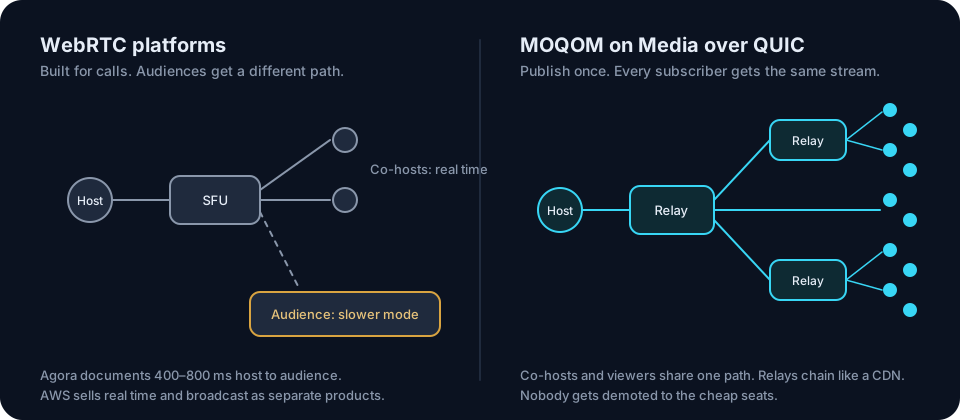
- One protocol for calls and broadcast. Built on the IETF’s Media over QUIC Transport
(targeting
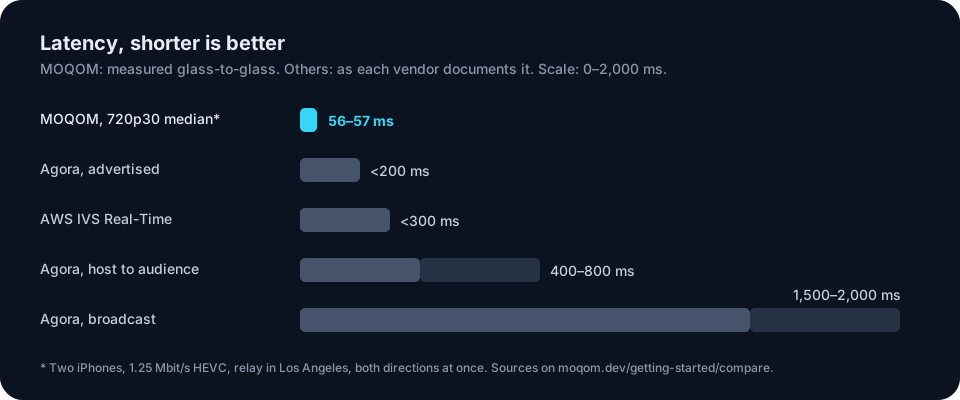
draft-ietf-moq-transport-19): the stream that carries a two-person call also reaches an audience of thousands, without moving to a second product. - Conversational latency, measured end to end. 56–57 ms median glass-to-glass at 720p30 (p95 70 ms), camera to screen on two iPhones.*
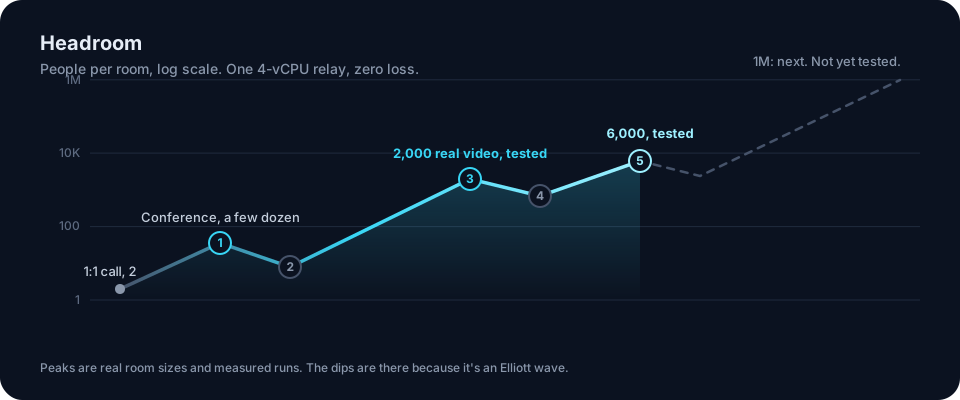
- Broadcast scale on modest hardware. 6,000 viewers on one 4-vCPU relay with zero loss (5.46 Gbit/s), the largest size tested.*
- Already ahead for calls and private rooms. Conferences, private rooms and one-to-one calls hold a few dozen people at most. We tested 6,000. Glass-to-glass is 56–57 ms, under Agora’s advertised “<200 ms”, and the price is lower at every tier.*
- The last viewer is as fast as the first, because it’s MoQ. WebRTC was built for calls, so big audiences get moved to a slower mode (Agora: 400–800 ms host to audience) or a separate product (AWS). Media over QUIC is publish and subscribe: relays forward the same media to every subscriber and chain like a CDN. Nobody gets demoted to the cheap seats.
- Scale is built in, not bolted on. Relays shard across cores, scale out and chain to other relays. The Go control plane scales out too.
- Encryption that costs almost nothing. Per-frame end-to-end encryption (SFrame, AES-256-GCM) at 54 µs per 1080p keyframe.* TLS 1.3 on every connection, always.
- Tokens bound to the device. A join token copied off one device does not work on another.
- Your relays or ours. Self-host relays and pay only the platform fee.
- Prepaid, cost-plus, capped. Capped 1¢ below Agora’s list price per 1,000 minutes at every tier, enforced in code.
- Open-source SDKs. Go and Rust backend SDKs and a Swift client shell are open source; the media cores ship as signed binaries.
Where we are honest about gaps
Section titled “Where we are honest about gaps”- Fewer platforms today. iOS and macOS are available. Web, Android, Desktop and the OBS plugin: Scoped, work ongoing, release planned October 2026.
- No independent audit yet.
- Not yet tested at a million viewers. So far: 6,000 on one 4-vCPU relay at 30 fps, and 2,000 watching real H.264 video at 2.78 Gbit/s, both with zero loss. A million is next. We’d rather measure it than say it.
- The protocol is still a draft. Media over QUIC Transport is an IETF Internet-Draft, not yet an RFC. MOQOM targets draft-19; the IETF published draft-22 on 1 Oct 2026.
- End-to-end encryption is opt-in per room, on Apple platforms today.
Against other platforms
Section titled “Against other platforms”Competitor figures are what each vendor’s own documentation says, accessed 6 Oct 2026. Where a vendor does not document something, we say so rather than guess. No latency figure below was measured by us on the same rig as MOQOM’s, so read them as published claims, not a head-to-head test.
Latency and scope
Section titled “Latency and scope”| Documented latency | Calls and broadcast | |
|---|---|---|
| MOQOM | 56–57 ms median glass-to-glass, 720p30 (measured in lab) | One stream and one protocol for both |
| Agora | “<200 ms global latency” (homepage). Docs: Interactive Live Streaming 400–800 ms host to audience; Broadcast Streaming 1,500–2,000 ms | One SDK; the audience latency level affects the price |
| Tencent RTC (TRTC) | Average end-to-end under 300 ms globally; live co-anchoring as low as 200 ms, viewing under 1 s | Calls and live rooms in TRTC; CDN delivery through Cloud Streaming Services: LEB 300–1,000 ms, HTTP-FLV 2–3 s, HLS 10–30 s |
| AWS IVS Real-Time | Under 300 ms host to viewer | Up to 12 publishers per stage; 10,000 subscribers per stage by default (adjustable); publish up to 720p. Stage broadcast to an IVS channel: those viewers get low latency |
| AWS IVS Low-Latency | Under 5 s | Broadcast only |
| AWS Chime SDK | Not documented | Meetings: up to 250 participants at 720p, or 25 at 1080p; replication to 10,000 / 1,000 |
| Google Cloud | No end-to-end figure documented; Live Stream API segments are 2–20 s (default 6 s) | Broadcast: Live Stream API (HLS/DASH) with Media CDN. No Google Cloud real-time video-calling SDK found; Meet Media API (Developer Preview) reads media from Google Meet calls |
| Cloudflare | Not documented for MoQ | MoQ relays (beta) on draft-14 and draft-16. Its MoQ docs list no Cloudflare client SDK for MoQ (examples use open-source moq-rs). WebRTC SDKs: RealtimeKit, Realtime SFU |
Price, encryption and protocol
Section titled “Price, encryption and protocol”| List price, video | Media encryption | Protocol | |
|---|---|---|---|
| MOQOM | Prepaid cost-plus, capped per 1,000 min at $3.98 HD, $8.98 Full HD, $15.98 2K, $35.98 2K+ | TLS 1.3 always; SFrame E2EE (AES-256-GCM) opt-in per room | IETF MoQ Transport, draft-19 |
| Agora | Per 1,000 min: $3.99 HD, $8.99 Full HD, $15.99 2K, $35.99 2K+; broadcast audience $1.99–$17.99 | Built-in media encryption opt-in; E2EE in beta (web, by request) | Agora SD-RTN™ |
| Tencent RTC | Per 1,000 min: $3.99 HD, $8.99 Full HD, $15.99 2K, $35.99 4K; live audience $2.00–$18.00 | Built-in transport encryption by default; private payload encryption opt-in, not available with cloud recording or CDN relay | UDP-based Tencent protocol; WebRTC on web |
| AWS IVS Real-Time | $0.072 per participant-hour (about $1.20 per 1,000 participant-minutes), North America, first 10,000 h, any resolution | Not stated on pages cited | Not stated on pages cited |
| AWS IVS Low-Latency | Output per hour delivered: $0.036 SD, $0.072 HD, $0.144 Full HD (North America, first 10,000 h), plus input $0.20–$2.00/h | Not stated on pages cited | RTMP, RTMPS or SRT ingest |
| AWS Chime SDK | $0.0017 per attendee-minute ($1.70 per 1,000) | DTLS transport; E2EE not stated on pages cited | WebRTC |
| Google Cloud | Not compared (broadcast product) | Content encryption: AES-128, SAMPLE-AES, MPEG-CENC | SRT/RTMP in, HLS/DASH out |
| Cloudflare | MoQ relays free during beta | Not stated on pages cited (MoQ) | IETF MoQ Transport, draft-14 and draft-16; draft-18 in testing |
AWS’s per-participant list prices are below MOQOM’s HD ceiling. MOQOM’s charge is cost-plus and depends on the bytes actually delivered, so compare on your own workload.
Notes by provider
Section titled “Notes by provider”Agora. Agora’s list price is MOQOM’s ceiling: at every tier MOQOM charges at most 1¢ less per 1,000 minutes, and the code enforces it. Agora bills by the total pixels a user receives; MOQOM uses the same tier boundaries so the cap compares like with like.
Tencent RTC. Tencent’s video tiers and list prices match Agora’s, with the top tier named 4K. TRTC documents that, to meet data-security storage requirements, it stores account and troubleshooting data in the Chinese mainland for Tencent Cloud customers and in Singapore for Tencent Cloud International customers, and that it processes audio and video only to deliver them, without storing them. Teams with data-residency or jurisdiction requirements should check which Tencent entity and region apply to their account. MOQOM runs on Google Cloud today, and you can run relays where you choose.
Google Cloud. Google Cloud’s Live Stream API takes SRT or RTMP in and writes HLS or DASH segments of 2–20 seconds to Cloud Storage for delivery through Media CDN: a broadcast pipeline, not a real-time one. MOQOM runs on Google Cloud today.
AWS. AWS splits live video across products: IVS Real-Time (under 300 ms, up to 12 publishers, 720p publish), IVS Low-Latency (under 5 s) for large audiences, and the Chime SDK for meetings. Viewers of a stage broadcast to an IVS channel get low latency, not real-time latency. MOQOM carries the call and the broadcast on one stream and one standard.
Cloudflare. Cloudflare runs MoQ relays across its network (beta, free during the beta), so MoQ is becoming infrastructure, not one company’s protocol. Cloudflare’s MoQ documentation lists no Cloudflare client SDK for MoQ; its examples use the open-source moq-rs tools, and its client SDKs (RealtimeKit) are WebRTC. MOQOM is the SDK and platform layer. We hope to partner with Cloudflare; no partnership is signed.
Sources (all accessed 6 Oct 2026)
Section titled “Sources (all accessed 6 Oct 2026)”- Agora pricing
- Agora latency by product
- Agora homepage (“<200ms global latency”)
- Agora media stream encryption
- Agora end-to-end encryption (Beta)
- Tencent RTC pricing
- Tencent RTC audio/video duration billing
- Tencent RTC live audience billing
- Tencent RTC latency (FAQs for Beginners)
- Tencent Cloud Streaming Services protocol latency
- Tencent LEB latency
- Tencent RTC security and default encryption
- Tencent RTC private encryption API
- Tencent RTC private encryption limits
- Tencent RTC data storage
- Tencent RTC data processing module
- Google Cloud Live Stream API overview
- Google Live Stream API segment settings
- Google Meet Media API
- AWS IVS Low-Latency
- AWS IVS Real-Time
- AWS IVS Real-Time quotas
- AWS IVS pricing
- AWS Chime SDK
- AWS Chime SDK pricing
- Cloudflare MoQ docs
- Cloudflare MoQ launch
- Cloudflare MoQ relay API, draft-14 and draft-16
- Cloudflare Realtime
- Cloudflare RealtimeKit
- IETF MoQ Transport